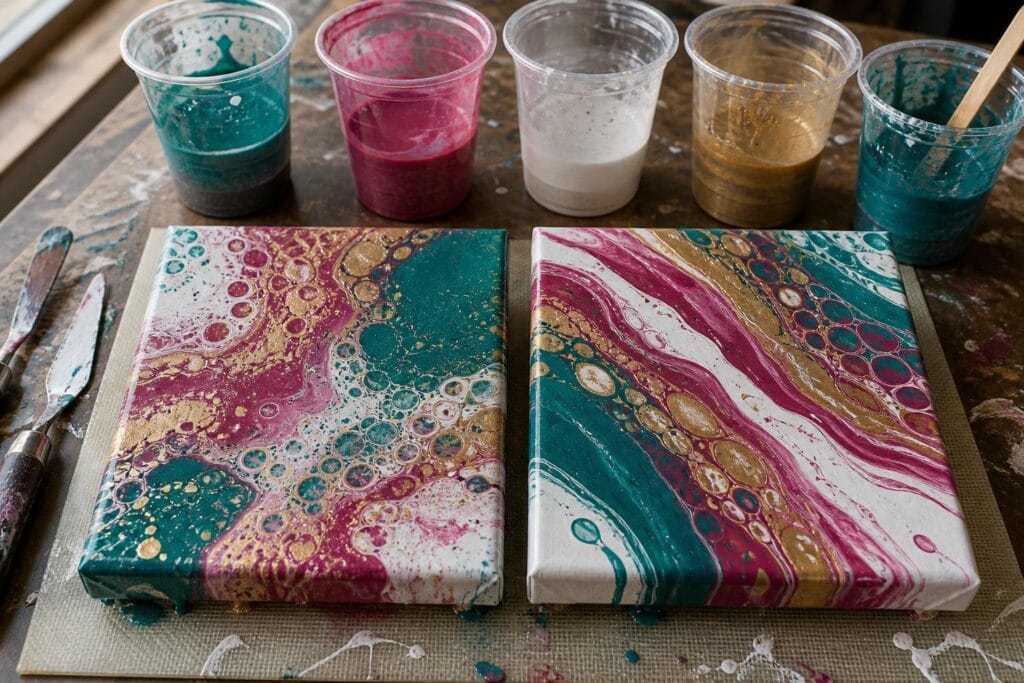
For a long time, I mixed every cup of acrylic pouring paint immediately before I poured. It felt sensible. Fresh paint seemed easier to trust, and I liked checking each color while my canvas and tools were already on the table.
Then I started preparing paint the night before busy pouring sessions. The first change I noticed was not dramatic color separation or a completely different flow pattern. It was how calm the paint looked. The foam and tiny bubbles created by stirring had time to rise, which gave me cleaner puddles and fewer pinpricks in the finished surface.
Resting paint can be genuinely helpful, but it is not a shortcut that removes the need to check consistency. Overnight paint may be smoother, thicker, separated, or settled depending on the pigments, pouring medium, water, temperature, and storage cup. The useful habit is not simply mixing ahead. It is learning how to inspect rested paint before it reaches the canvas.
What Actually Changes While Pouring Paint Rests?
Freshly mixed paint contains more air than most beginners realize. Stirring folds tiny pockets of air into the mixture, especially when thick paint is being combined with pouring medium. A wooden stick can make the surface look smooth while many smaller bubbles remain suspended underneath.
When the cup sits undisturbed, those bubbles gradually travel upward and break. In my experience, eight to twelve hours of resting makes the biggest visible difference in mixtures that required vigorous stirring. This is especially useful with white, since bubbles and surface pits tend to show clearly in a white base or negative space composition.
Resting also gives the ingredients time to become more evenly combined. I have noticed that some budget acrylics look slightly lumpy just after mixing but become silkier after several hours in pouring medium. That does not mean resting can rescue dried paint chunks or a poor recipe. It simply allows a properly mixed cup to settle into a more uniform consistency.
At the same time, gravity is working on the pigment. Dense pigments can sink, while lighter liquid may collect near the surface. Metallics, some whites, and paint containing mica are especially likely to settle. What surprised me most was how normal a separated cup could look again after slow, careful stirring. Separation does not automatically mean the paint has spoiled.
Why Rested Paint Can Produce a Smoother Pour
Fewer suspended bubbles can mean fewer tiny craters after the paint dries. This matters in acrylic pouring because a bubble that appears harmless during the pour can open later as the surface levels and moisture evaporates.
Rested paint also lets me use less heat. A quick pass with a torch or heat tool can release surface bubbles, but relying on heat to correct an aggressively mixed batch creates other risks. Too much heat can form a skin, disturb cells, scorch paint, or make one area dry differently from the rest. I would rather let time remove most of the air and use minimal heat only when needed.
I learned this after mixing a large batch of colors with a small electric mixer. The cups looked beautifully blended, but the resulting ring pour was full of tiny bubbles. I kept applying heat, loosened the pattern I liked, and still found pinholes after drying. The same recipe, stirred by hand and rested overnight, poured much more cleanly.
There is a tradeoff. Mixing ahead improves bubble release and makes a pouring session feel less rushed, but it can hide changes in consistency. A poorly sealed cup may thicken overnight. A very watery mixture may separate. Heavy pigment may settle enough to affect the first paint poured from the cup. Resting helps only when the paint is checked again.
How I Store and Check Paint Before Pouring
My preferred beginner approach is to mix the paint and pouring medium the night before, cover each cup tightly, then make final adjustments shortly before pouring. This provides the benefit of resting without asking a beginner to predict exactly how every color will behave twelve hours later.
Mix each acrylic color with pouring medium until no obvious streaks remain. Scrape the bottom and sides of the cup because thick paint often hides there.
Add water gradually if the recipe needs it. I stop when the paint is close to my intended consistency rather than making it unusually thin in anticipation of overnight thickening.
Cover the cup with a fitted lid or a tight layer of reusable wrap. Paint exposed to air can develop a skin, and even small dried pieces may drag through a pour.
Store the cups upright at a stable room temperature away from direct sun, heaters, and freezing conditions.
Before pouring, inspect the surface and bottom. Look for a skin, watery separation, settled pigment, dried pieces, or an unexpected odor.
Stir slowly with a few deliberate turns. Then lift the stick and watch how the paint falls into the cup. It should form a steady stream and disappear back into the surface without sitting as a stiff mound or vanishing instantly like colored water.
One mistake I see often is remixing rested paint as vigorously as it was mixed the first time. That puts the air right back into the cup. Slow stirring is usually enough to reincorporate settled pigment. If the mixture needs a substantial correction, make it and allow another short resting period before pouring.
If I am using silicone oil, I prefer adding it after the consistency check rather than letting it sit overnight. This gives me better control over how many drops enter each color and how much I stir them. For beginners, adding every ingredient at once can make cell results harder to understand.
When Freshly Mixed Paint Is the Better Choice
I do not mix ahead when I am experimenting with an unfamiliar paint and medium combination. I want to observe how that mixture behaves immediately, how quickly it thickens, and whether it separates. Fresh mixing also makes sense when I am adjusting colors by eye for a small pour. Saving several nearly identical versions overnight can create more confusion than convenience.
Fresh paint may also be preferable for techniques where I want to make quick consistency adjustments between colors. A swipe, Dutch pour, and straight pour do not always need the same viscosity relationships. If I am still deciding on the technique, I wait to finalize the mixtures.
However, for a planned flip cup, ring pour, or layered cup with a familiar recipe, I usually choose overnight preparation. It reduces bubbles, protects my creative energy, and lets me begin the pour by studying the colors rather than rushing through six cups of mixing.
Troubleshooting Rested Pouring Paint
Why is there clear liquid on top?
A small amount of separation can often be stirred back in slowly. Check the flow afterward. If the mixture repeatedly separates within minutes, the paint may be too diluted or incompatible with the chosen medium. I would test it on a small surface instead of risking an important canvas.
Why is the paint thicker in the morning?
The cup may not have been sealed tightly, or the paint may simply have absorbed the medium slowly. Add only a tiny amount of water or medium at a time. Large corrections can take the mixture from sluggish to watery very quickly.
What if a skin formed on top?
Remove the skin without breaking it into the paint. Do not stir it in. I strain the remaining mixture if I suspect small dried pieces are present, since one fragment can interrupt a ring, clog a nozzle, or leave a raised mark.
Can mixed paint sit longer than one night?
Often it can when stored in a clean, tightly sealed container, but I check it more critically each day. Recipes containing extra water require particular care. If the smell changes, mold appears, or the texture cannot be restored with gentle stirring, I discard it.
Overnight mixing is not a rule for successful acrylic pouring. It is a useful choice when bubbles are bothering you or preparation is stealing the fun from your pouring session. Start with one familiar recipe, rest half the colors, mix the others fresh, and compare the dried results. That small experiment will tell you more about your own paints and studio conditions than any rigid mixing schedule.
